
August Festes Patronals: The Party Ibiza Throws for Itself
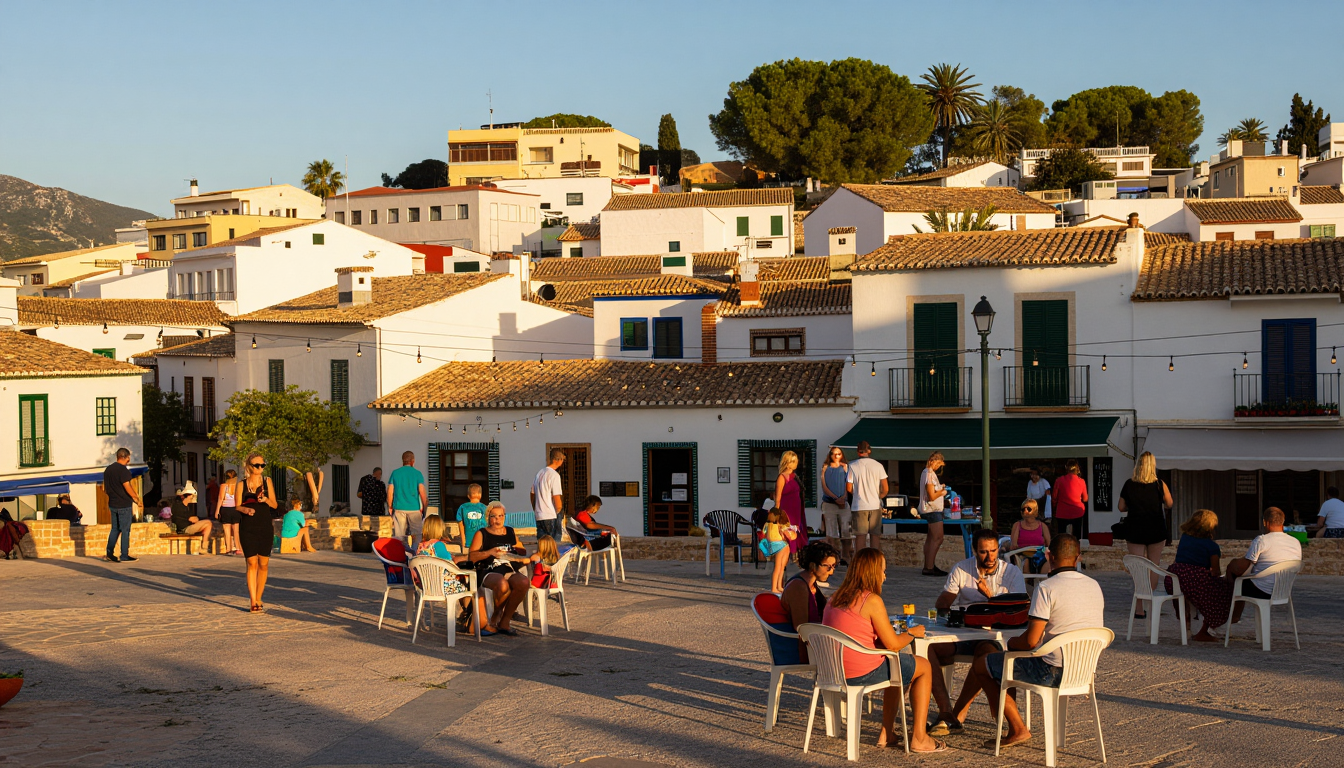
Every village on Ibiza has a patron saint, and in August most of them throw a party for it. That is a festa patronal: a mass, a procession around the church, a ball pagès in the square, food somebody's family cooked, and a band playing covers until two in the morning. They are free, nobody checks a ticket, anyone who turns up is welcome. What they are not is entertainment programmed for visitors, and that is most of what you need to know to enjoy one without getting in the way.
What a festa actually looks like
The bones are the same everywhere. Early evening, mass in the parish church: one of those small fortified white churches you drive past all summer, suddenly full and lit. Then the saint's image comes out and goes once around the square, accompanied by whoever wants to walk. The colla, the village dance group, sets up in front of the church and dances the ball pagès to a three-hole flute, a drum, castanets and the espasí, a metal blade struck with a key. After that the square becomes a village party: the neighbours' association running a folding-table bar, watermelon, coca, hierbas going round, kids on scooters at midnight, grandmothers in plastic chairs at the edge.
Some villages add a correfoc, open-air cinema, a paella for several hundred, fireworks. Sant Antoni's Sant Bartomeu, on 24 August, ends with a display over the bay that pulls in the whole west of the island. In Vila, Sant Ciriac on 8 August marks the 1235 conquest with an offering at the small chapel in Dalt Vila and, straight after, a watermelon fight that will ruin your clothes. Sant Llorenç, on the 10th, falls on the nights of the Perseids: a tiny village, a small square, a very dark sky.
Ball pagès is not a show
This is where visitors most often get it wrong. It is not folklore staged for an audience but a courtship dance the village performs for itself and its saint, in the same square, on the same night, every year. The woman moves in short contained steps with her eyes down, tracing a slow figure across the ground; the man leaps and stamps around her. It reads as stiff if you expect flamenco. It is not flamenco, and clapping along on the beat announces that you have misread the room.
The clothes are not costumes either. The gonella, the shawl and above all the emprendada — the layered gold and coral necklaces the women wear — are family pieces, often inherited, out of the safe three or four times a year. The woman wearing them is a neighbour who works at the health centre, not a model waiting to pose. If the dress interests you, the island's Adlib style grew out of it, and an hour inside an Ibiza atelier teaches more than any photograph.
If what you want is a performance, with a table and a start time, flamenco at a country finca does that without pretending to be anything else — Andalusian rather than Ibicencan. A festa is not a substitute for it.
Where to stand and what to photograph
Stand behind the ring of villagers, never inside it. The circle around the dancers forms itself; if you have a clear view and nobody in front of you, you are almost certainly somewhere you should not be. In the church, sit at the back, cover your shoulders and leave the phone in your pocket. On the procession, do not walk backwards in front of the saint filming: let it pass and shoot from the side.
Wide shots of the square, the church, the dancers mid-figure: nobody minds. Close portraits: ask, in whatever Spanish you have, and take a no without pushing. Children who are not yours: no. Flash: never, least of all at the colla. Nobody will confront you over any of this, which is exactly why it is worth getting right.
Beachwear is out. Buy drinks at the association's bar rather than bringing your own — that bar is how the fiesta gets paid for — and carry small cash, because there is no card machine. If food is handed round, take one portion, after the elderly and the children.
The parts that are not on the poster
Parking is the real obstacle. A village square holds a few dozen cars and the village fills them by seven; leave yours on a dirt shoulder well before the houses, never across a gate or a farm track, and walk in. Times slip: a ball pagès announced for ten starts nearer eleven, so do not book a restaurant for later. There is one toilet, in the bar, with a queue. Food runs out. The music goes on until three, charming from the square and much less so from a bedroom above it.
August heat is the other thing: mass at eight, the square still at thirty degrees by ten. For the same villages shuttered and quiet, go any other day — a loop through the white villages of the north covers several in an afternoon. And if the food is the draw, an Ibicenco cooking class is how to take flaó and greixonera home.
Getting this year's programme, not last year's
Saints' days are fixed; the programme around them is not. Town halls move the big nights to the nearest weekend, reorder events and publish late, sometimes days before. Any list on a blog, including the dates in this article, is a rough shape and nothing more.
The reliable sources are the five town halls — Eivissa, Santa Eulària des Riu, Sant Antoni de Portmany, Sant Josep de sa Talaia and Sant Joan de Labritja — each of which publishes its programa de festes as a PDF in the agenda section of its website, usually posting it on social media first. The Consell d'Eivissa and the island's tourism board keep island-wide cultural calendars, useful for seeing what falls in a given week. And the oldest method still works: the poster taped to the church door and the bar window in the village itself. Always current, never wrong.