
Ibiza's Six Official Eclipse Zones, Beach by Beach
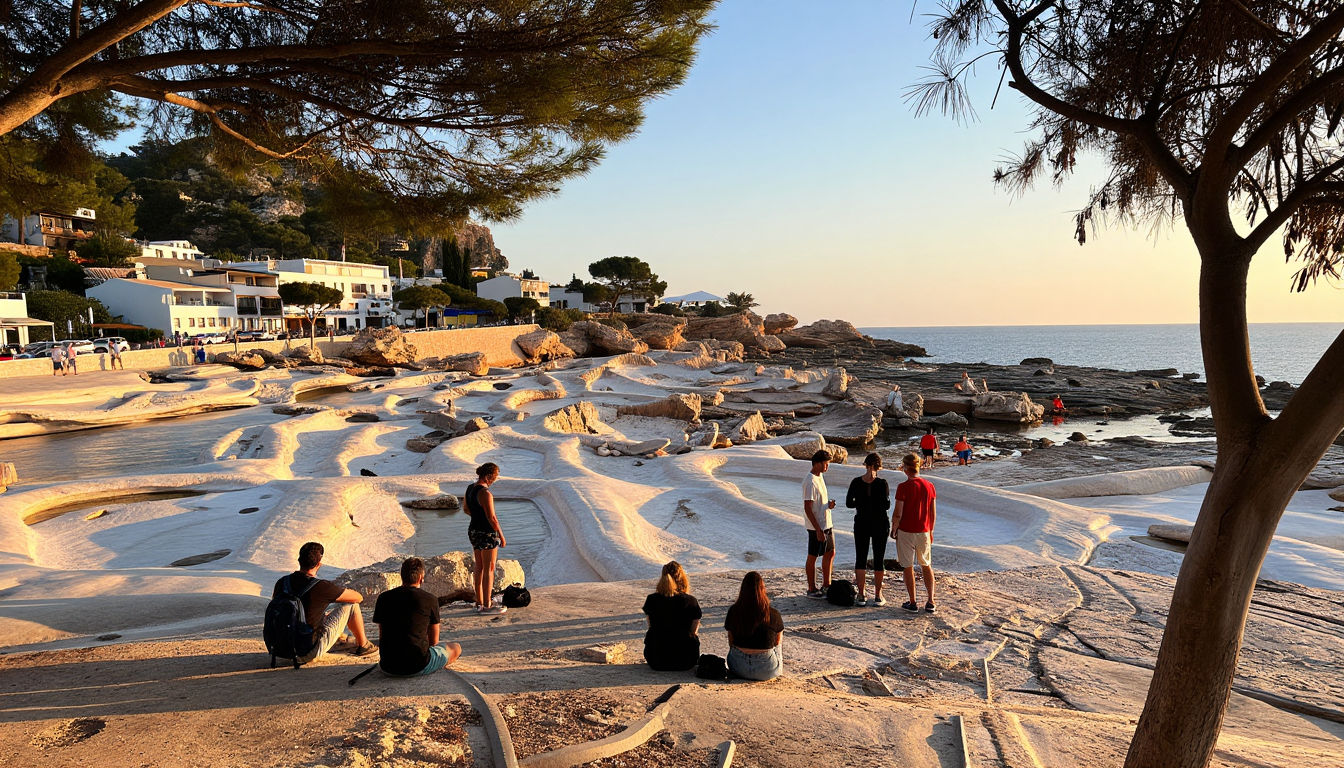
The Govern balear has designated 26 official observation zones for the total solar eclipse of Wednesday 12 August 2026, and six of them are in Ibiza: Cala Gració, Cala Molí, Cala Comte, Sa Pedrera at Port des Torrent, Cala Llentia and the Sant Antoni coast. They share the feature that decides everything on Wednesday: all of them face west. Totality arrives here around 20:32–20:33, with the sun barely two or three degrees above the sea and minutes from setting, and it lasts less than a minute, about fifty seconds. A headland, an apartment block or one tall pine in the wrong place takes all fifty of them off you.
Fifty seconds, two degrees up
The partial phase begins at about 19:38 Balearic time, and for most of the hour that follows it will look like an ordinary August evening with something faintly wrong about the light. Two or three degrees is about two fingers held up at arm's length, and that is all the room the eclipsed sun will have above the water. You are not choosing a beach on Wednesday; you are choosing a horizon.
The band of totality crosses Spain west to east, over A Coruña, Oviedo, León, Bilbao, Zaragoza and Valencia, enters the islands through Menorca and runs over Mallorca, where totality lasts about a minute and a half, before touching Ibiza and passing over Formentera. One more thing: in August the last degrees above the sea are often thick with haze, and the sun can go copper and blurred before it reaches the true horizon. Nothing to do about that except stand where the water is most open.
Cala Comte and Sa Pedrera: the open horizons
Cala Comte is the island's default sunset beach and the most open of the six, low rock shelves stepping into the water between small sandy bays, with nothing to the west but sea and the islets offshore. Those islets are the catch: with the sun two degrees up, an island on the horizon line is not scenery, it is a wall. Arrive with enough daylight to walk the shelves and pick a line of sight that clears them. Otherwise it behaves like one of the busiest sunset spots on the island in August: a car park that fills, one road in and the same road out, a slow exit even on a normal night, beach bars and toilets in season, rock sharp enough to want real shoes. On any other evening a laid-out picnic on those rocks is a civilised way to hold a spot; this week, holding the spot is the whole job.
Sa Pedrera, on the shoulder of Port des Torrent, is the unglamorous one and probably the most practical. Flat pale quarry-cut rock runs straight into the sea, wide open west, with a resort behind it instead of a cliff. That is the advantage: paved road, bus route, bars and toilets a short walk away, somewhere to leave the car that is not a dirt clearing, no descent and no climb back. Bring something to sit on; cut stone is hard and the edges are sharp.
Cala Molí, Cala Llentia and Cala Gració: the small ones
Cala Molí sits at the foot of a ravine between Cala Tarida and Cala Vadella, down a narrow road that switchbacks to a handful of spaces and a restaurant above the sand. There is room for very few people at the water's edge, and the ravine walls frame the sky more tightly than they seem to at midday. Go absurdly early or don't go, and remember the climb back in the dark.
Cala Llentia is rock rather than sand, down a dirt track off the Cala Codolar road, with a clearing among the pines for cars and a stone-circle sculpture on the flat ground above. No bar, no toilets, no lighting: what makes it quiet on a normal evening makes it awkward on this one. The shore is uneven near the water, and a torch is not optional.
Cala Gració is the kindest of the three, just north of Sant Antoni or a walk along the coast path, with a beach bar, showers and a small roadside car park that fills early in August. Pick it if you are with children or with someone who would rather not scramble. The price is its shape: a narrow sheltered inlet with rocky arms either side, lovely for swimming and restrictive for a sun sitting on the water. Get as far towards the mouth as you safely can.
The Sant Antoni coast: easiest to reach, impossible to have to yourself
The sixth zone is the town's own west-facing front, from the port along the promenade to Caló des Moro and the rocks beyond. Flat, paved, lit, buses and taxis, bars and toilets behind you, no parking space to hunt for, and most of Sant Antoni standing next to you. From inside the bay its own arms sit low on the horizon, so the further west along the front you get, the cleaner your line to open water. If you are in town that afternoon anyway, the free walking tour of Sant Antoni fills the hours without a car. A boat, of course, has no headland in front of it at all, and a west-facing trip like the Es Vedrà sunset cruise is in theory the best seat there is, though whether anything sails that evening is for the operators and the authorities to say.
Filters, not sunglasses
A certified solar filter is needed for the whole partial phase, from 19:38 until totality itself. A low sun veiled in haze is not safer to look at, and that intuition is precisely the one that injures people. Sunglasses are not filters: not stacked, not polarised, not the very dark ones. Cameras, phones, binoculars and telescopes each need their own filter in front of the lens, and an unfiltered optic aimed at the sun with your eye behind it does damage instantly.
What to check on the day
Access rules, capacity, whether you can drive down to a given cove or have to walk in, whether a zone closes once it is full: the Govern sets and publishes all of that at eclipsisegur.caib.es. It can change during the week and on the morning itself, so read it on Wednesday rather than trusting any article, this one included. Then leave earlier than feels reasonable, take a torch and something to sit on, and plan the way out as well as the way in, because everybody leaves at once, in the dark, down the same single-lane roads. Fifty seconds is worth a long wait. It is not worth watching through a windscreen.