
Fifty Seconds at Sunset: How to Watch the Ibiza Eclipse Safely — and Get Home After
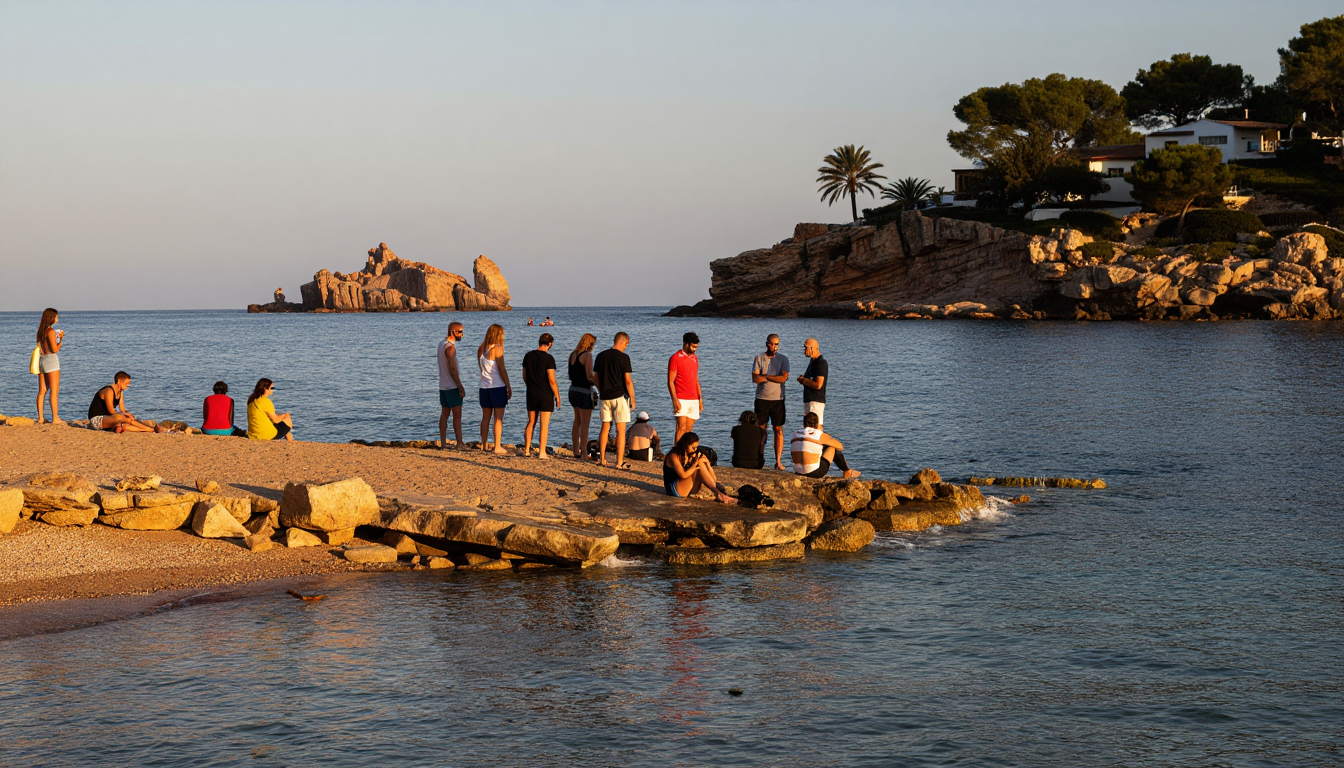
On Wednesday 12 August 2026 a total solar eclipse crosses Spain from west to east, and Ibiza catches the tail of it. The partial phase begins at around 19:38 Balearic time, the sun is fully covered at roughly 20:32–20:33, and totality here lasts less than a minute — somewhere near fifty seconds. All of it happens with the sun two or three degrees above the western horizon, minutes from setting. That single fact shapes the whole evening: whether you see anything at all, what has to sit in front of your eyes and your lenses, and how you get home afterwards, which is the part almost nobody plans for.
Fifty seconds, very low, facing west
The band of totality crosses the mainland through A Coruña, Oviedo, León, Bilbao, Zaragoza and Valencia before reaching the Balearics: Menorca first, then Mallorca and Palma, then Ibiza, then Formentera. Mallorca gets around a minute and a half of it. Ibiza gets its fifty seconds with the sun almost touching the water.
Two or three degrees is nothing. A ridge of pines, a hotel block two streets inland, the headland that closes off your cove, a bank of haze sitting out to sea — any of them takes the sun before the moon does. An open western horizon matters more than any other choice you make that day, and it is worth checking on the ground in daylight rather than trusting a map.
The filter goes on at 19:38 and stays on
From the first bite out of the disc until totality begins — close to an hour — a certified solar filter has to be between the sun and your eyes every single time you look. Sunglasses do not count: not two pairs stacked, not polarised, not the darkest ones you own. Neither does smoked glass, an old strip of photographic film, welding glass whose grade you cannot verify, or a phone screen held up as a shield. The Balearic government keeps the current rules and the list of what actually qualifies at eclipsisegur.caib.es.
The filter comes off only for the seconds of totality itself, and goes straight back on. With a window this short, plenty of people will decide not to remove it at all and simply watch the light go strange around them. That is a perfectly reasonable way to do it.
An orange sun near the horizon is the trap
The most dangerous stretch of the evening is the one that feels safest. A low sun softened by calima looks tame; you can glance at it on any July evening and nothing happens. What the eye is judging is visible brightness, and a good part of what damages the retina is radiation it never registers as glare. The retina has no pain receptors either, so nothing tells you to look away, and the injury tends to announce itself hours later or the next morning.
The thought "it's mild enough tonight" is exactly the thought that fills ophthalmology clinics the week after an eclipse. If you are looking towards the sun and it is not fully covered, the filter is on.
Cameras, phones and binoculars need filters of their own
A filter over your eyes protects nothing that has a lens in front of it. Binoculars, a telescope or a long telephoto gather light and concentrate it; pointing them at the sun unfiltered is worse than looking with bare eyes, and eclipse glasses are not built to survive that concentrated beam. The filter goes in front of the objective, on the sky side, never at the eyepiece.
Phones are the same story in miniature. The sensor can be damaged and the reward is a small orange blob. With fifty seconds on the clock, the honest advice is to watch rather than shoot; someone standing a few metres away will have a better photograph online that same night.
Where to stand
The Balearic government has set up 26 official viewing zones across the four islands. In Ibiza they are Cala Gració, Cala Molí, Cala Comte, Sa Pedrera at Port des Torrent, Cala Llentia and the Sant Antoni seafront. All of them face west, which is the entire criterion; the official list, and whatever access rules end up applying, are on eclipsisegur.caib.es.
They are not equivalent in practice. The Sant Antoni seafront has pavement, streetlights and somewhere to leave a car that is not a dirt verge. The coves give you a cleaner horizon and a considerably worse exit. Cala Comte is the kind of place that already fills up on an ordinary August evening: an evening picnic on the rocks there is a normal Ibiza plan, and that night it will not be normal. Out on the water there is nothing in the way at all, so if you had a sunset sail under Es Vedrà in mind, ask the operator directly what they are doing on the 12th before assuming anything.
The part nobody plans: everyone leaves at once, in the dark
Totality ends and the sun sets a few minutes later. There is no golden hour to stretch the departure out or spread people around. Everyone who drove down to a cove walks back to the car park at the same time, in the dark, along paths of loose rock and pine roots.
Bring a real torch or a head torch. The phone one eats the battery you will want for the drive back and lights the ground badly; people who run things like a torchlit night snorkel do not use phones for a reason. Walk the path down while there is still light and note where the steps and the awkward rock are.
Do not park on the verge of a cove road. They are narrow, and a line of cars on the shoulder turns them into a single lane at the precise moment everyone wants to leave — and it is the same lane an ambulance would need. Park where you would be happy to be parked at midnight and walk the last stretch. Assume the drive back is slow, do not book dinner for straight afterwards, and drive expecting people on foot in dark clothes along unlit roads. If you can get to the Sant Antoni seafront without a car, that is the version of the evening with the fewest ways to go wrong — check the return timetable before you rely on it.
One honest note to close. At two or three degrees, a bank of cloud out at sea is enough to leave you with nothing, and no amount of planning fixes that. Go anyway: the sky turns strange in a way that justifies standing outside for it, even with the filter on.