
Total Solar Eclipse in Ibiza on 12 August 2026: What Happens, and When
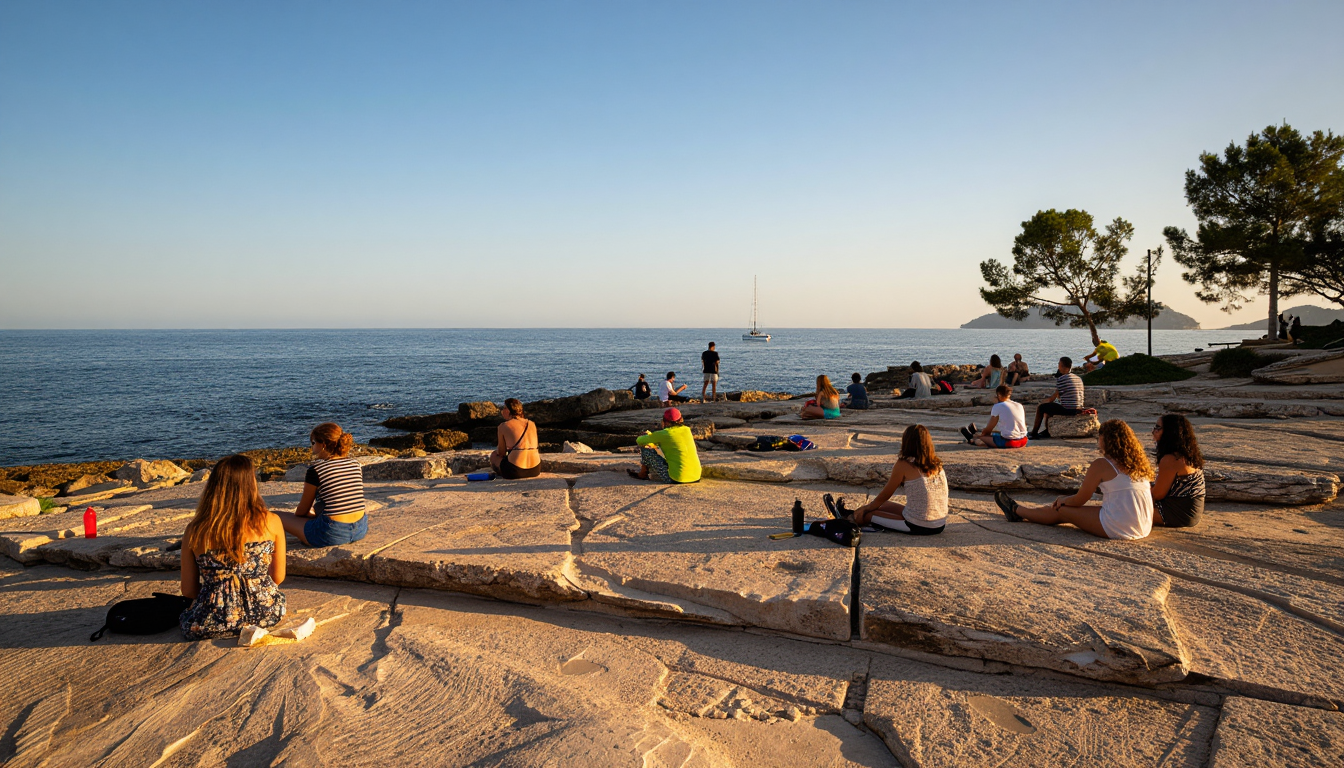
If you are on the island this week and have only just heard about it, here is the short version: on Wednesday 12 August 2026, Ibiza is inside the path of totality of a total solar eclipse. Not a partial one. Seen from here, the Moon covers the Sun completely at around 20:32-20:33 local time, for a little under a minute. The partial phase begins at roughly 19:38. The complication, and it is a serious one, is that the Sun will be only two or three degrees above the western horizon when it happens, minutes from setting. Where you stand decides whether you see it at all.
Ibiza is inside the band, not beside it
The most common assumption on the island right now is that the real eclipse belongs to the mainland and that the Balearics get a nibble of it. That is wrong. The path of totality crosses Spain from west to east — A Coruña, Oviedo, León, Bilbao, Zaragoza, Valencia — and carries on over the Mediterranean to the islands. It reaches Menorca first, then Mallorca, then Ibiza, and it passes over Formentera as well. Palma is on the line too.
What changes from island to island is how long totality lasts. Mallorca gets around a minute and a half. Ibiza gets less than a minute — in the region of fifty seconds. That difference sounds academic on paper and stops sounding academic when you are standing on a rock with a filter in your hand. Fifty seconds is barely enough time to lower the filter, look, and understand what you are looking at. Everything else about the evening should be arranged so that nothing at all is unresolved by 20:30: not the parking, not the walk in, not where in the group everybody is standing.
How the evening unfolds, from 19:38
At around 19:38 the Moon takes its first bite out of the edge of the Sun. You will not notice this with the naked eye, and you should not try to: at that point the Sun is still an ordinary, blinding August sun that happens to be very slightly less round than usual. It only exists through a filter.
Between then and totality the crescent thins. The light is the part worth paying attention to. It does not fade the way normal dusk fades; it thins out, goes faintly metallic, and the dappled shade under a pine turns into rows of little crescents. Because all of this is happening at the end of the day, the ordinary golden-hour change and the eclipse change overlap, and it is easy to talk yourself into believing nothing unusual is going on until the final few minutes.
Then, at about 20:32 or 20:33, totality. Under a minute of it. Afterwards the Sun returns as a sliver, very low over the water, and sets shortly after — so the second half of the partial phase is cut off by the horizon rather than running its course.
Two or three degrees is the whole story
Hold your arm straight out and put two fingers together. That is roughly how high the Sun will be above the true horizon at the moment of totality. Everything practical about Wednesday follows from that one number.
It means a hill blocks it. A stand of pines blocks it. A four-storey apartment block at the end of the street blocks it. A headland that looks low and harmless when you are lying on the beach blocks it. Most of the interior of Ibiza is hills and pine, so from inland the western horizon is a ridge line rather than a line, and a ridge a few degrees high is enough to hide the entire event.
Height does not automatically solve it either. Climbing only helps if the view opens all the way down to the sea in the west. A high point with trees on its western side is worse than a flat rock at sea level with nothing in front of it. The rule is simple and it is the only one that matters: you want open water to the west. Beach, rock shelf, cliff top or boat deck — if you can see the line where the sea meets the sky in the direction the Sun sets, you are in the right place.
The official viewing zones
The Balearic government has set up 26 official observation zones (ZOO) across the four islands. In Ibiza they are Cala Gració, Cala Molí, Cala Comte, Sa Pedrera at Port des Torrent, Cala Llentia and the Sant Antoni coast. All of them face west, which is precisely the point.
One thing worth clearing up: that Sa Pedrera is the one at Port des Torrent, not the Atlantis quarry down near Cala d'Hort, which is also called Sa Pedrera and which people mix up constantly. The Atlantis hike is a good west-coast walk on any other day, but the way out is a steep scramble and you would be doing it in the dark after 20:33. Not on Wednesday.
These are small coves with small car parks and narrow access roads, and they are the same coves the whole west of the island already heads to on a normal August evening. If you would rather not fight for a place on the rocks, a sunset picnic at Cala Comte puts you there with the logistics handled, though it is worth confirming with the host that the timing lines up with 20:33 — a normal sunset booking is built around a different clock.
Filters, not sunglasses
You need a certified solar filter for the whole of the partial phase, from 19:38 onwards. Sunglasses do not work. Two pairs of sunglasses do not work. Smoked glass and exposed film do not work.
The specific trap on Wednesday is the low Sun. A sun sitting two degrees above the sea and softened by haze looks harmless and feels comfortable to stare at. That intuition is exactly the one that causes eye injuries: comfort is not protection, the damaging light is still arriving, and there is no pain to warn you while it does. Anything with a lens needs its own filter in front of it too — phone, camera, binoculars, telescope. A filter over your eyes does nothing for a device pointed at the Sun, and a device pointed at the Sun without one can be ruined in seconds. The only moment the filter comes off is totality itself, and here that is under a minute. The current rules and official guidance are at eclipsisegur.caib.es; read them before Wednesday, not on the way there.
Pick the horizon, then arrive early
Go west, find sea, get there with hours in hand. The roads to the west coast are narrow and they will be carrying an evening's worth of traffic into car parks that fill on ordinary Wednesdays. Parking a good walk away and going the last stretch on foot is not a sacrifice, it is the plan that works.
Being on the water removes the horizon problem entirely — a sunset cruise towards Es Vedrà has nothing in front of it but open sea — but only if the boat is genuinely out there at 20:33, so confirm departure and return times rather than assuming them. Formentera is inside the band as well, and a day escape by ferry is tempting, but that trip is built around daylight and around the crossings back; if you go, know your last ferry before you commit to watching an eclipse from there.
Otherwise it is straightforward. A west-facing spot, a filter you already own, and a willingness to stand around doing very little from 19:38 until the fifty seconds that the whole evening is for.