
Which Way the Coast Faces: Planning an Ibiza Day Around the Light
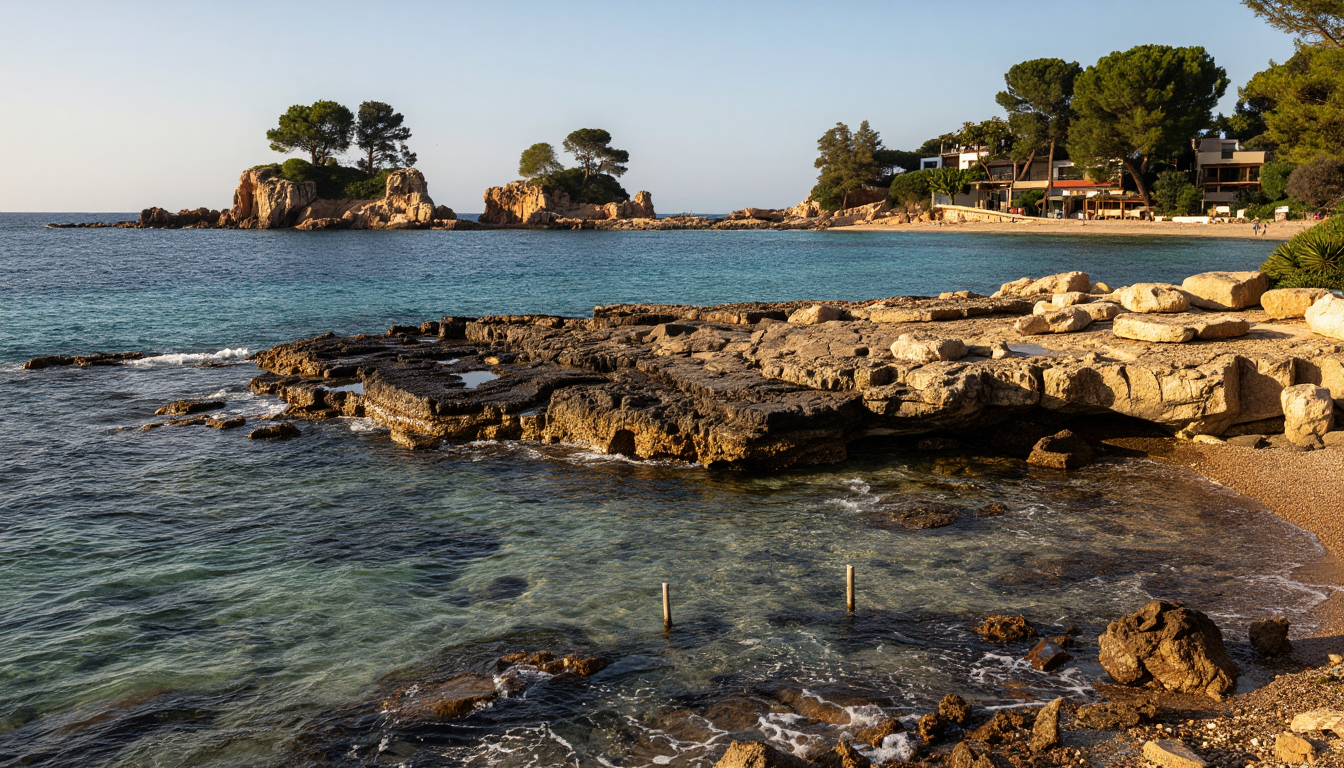
Ibiza measures roughly forty kilometres corner to corner and you can drive across it in an hour, so the real difference between two coves is rarely the sand. It is which way they point. The west coast faces the sunset head-on; the east coast takes the sun as it comes up out of the sea. Plan a day around that one fact — light first, beach second — and you end up with flatter water, better colour and a lot less company than the people working through a list of names.
Which coast faces where
Put a map in front of you with north at the top. The entire western flank — Sant Antoni bay, Cala Bassa, Cala Comte, Cala Tarida, Cala Molí, Cala Vadella, Cala d'Hort — opens somewhere between northwest and southwest. That arc is precisely where the sun goes down. In late June it sets at about 300 degrees, well north of due west; by December it has swung back to around 240. So in high summer the sunset sits over open water for anyone on the Sant Antoni side, and as the year turns it slides south, down toward Es Vedrà.
The east is the mirror image. Cala Sant Vicent, Cala Boix, Pou des Lleó, Es Canar, Cala Llonga, Talamanca and Es Cavallet all look out between northeast and southeast, and the sun comes up in front of them out of the sea. The north is less consistent than people assume: Portinatx and Cala Xarraca face more or less due north and sit in flat, even light most of the day, while Benirràs, despite being on the north coast, is cut into a west-northwest notch in the cliffs. That is why the drum circle ended up there and not two headlands along. The south, meaning Ses Salines and the salt pans behind it, faces roughly south-southwest and holds sun longer than anywhere else.
Why the west fills up after five
A coast that faces the sunset is not a secret, and the consequences are logistical. In July and August the Cala Comte car parks are full by five in the afternoon and cars start lining the approach road, which adds a ten or fifteen minute walk at each end. Cala Comte is also almost entirely without natural shade: low limestone, thin pines set back from the water, nothing over the sand. Between noon and four it is hard work, so the comfortable hours and the busy hours are the same hours. If you want a table and no queue, a set-up picnic at Cala Comte solves the part of the problem that arriving early does not.
Narrow coves have the opposite fault, and Cala Molí is the one that catches people out. It is a deep notch with high pine-covered sides, and because the summer sun sets well north of due west, the headland on its northern flank can take the light off the sand half an hour or more before the sun reaches the horizon. Good if you want to swim in shade at six; disappointing if you drove there for the sunset. The rule generalises: in any enclosed cove, look at the headlands that frame it, not only at the open water in front.
Mornings belong to the east and the north
At seven or eight the sun is low over the water on the east side and the sea has not yet been touched by wind. It is flat, often literally mirror-flat, and visibility underwater is at its best because nothing has been stirred up overnight. Anything that depends on calm — snorkelling, a kayak, a board, a small boat — is a morning activity here rather than an afternoon one. The paddle safari along the north coast goes out early for exactly that reason.
The west coast in the morning is worth a mention too, because it is empty. The sun comes up behind the land and lights the cliffs face-on: from the Cala d'Hort viewpoints, Es Vedrà is lit rather than silhouetted, and there is nobody there. Sunrise yoga above Es Vedrà is one use of that hour; driving up before breakfast is another.
One caveat for anyone with a camera. Sunrise on the east coast means shooting into the sun, which is dramatic and difficult. If what you want instead is the turquoise — sand read through clear water — you need the sun high and over your shoulder rather than in front of the lens, and that inverts the timetable: the east coast works in the early afternoon, once the sun has crossed over the land behind you, and the west coast in the late morning, before it swings round in front. The famous sunset hour at Cala Comte is lovely and useless for that particular photograph.
The afternoon wind is half the timetable
The sea breeze — the embat, in Balearic — is the part visitors miss. Dawn is calm, the breeze builds through the late morning, peaks in the middle of the afternoon and usually drops off around sunset. On the west coast it tends to come in from the west or southwest and pushes straight into those open, sunset-facing bays. By three o'clock Sant Antoni bay has a short, tiring chop on it.
This matters more than it sounds. A paddle out that took thirty minutes can take an hour coming back against the wind, and the same chop lifts sand and cuts underwater visibility, so west-coast snorkelling after mid-afternoon is milkier than the same spot at nine. If you are going out on a board, take the early slot: the small-group paddle in a Sant Antoni cove is a different exercise at ten than at four. Sailing boats have it easier, and a sunset trip is usually leaving as the breeze softens.
Building the day
The shape that works is straightforward: east or north first thing, inland or in shade through the middle, west for the last two hours. The clock moves fast across the season — sunset is around 21:20 in late June, 20:45 in mid-August and 19:40 by the end of September, and once the clocks go back in late October the sun is down before six. That last shift is the useful one. In the first half of October there is still light past seven, the west coast is quiet, and you can be at Cala Comte at six with room to park.